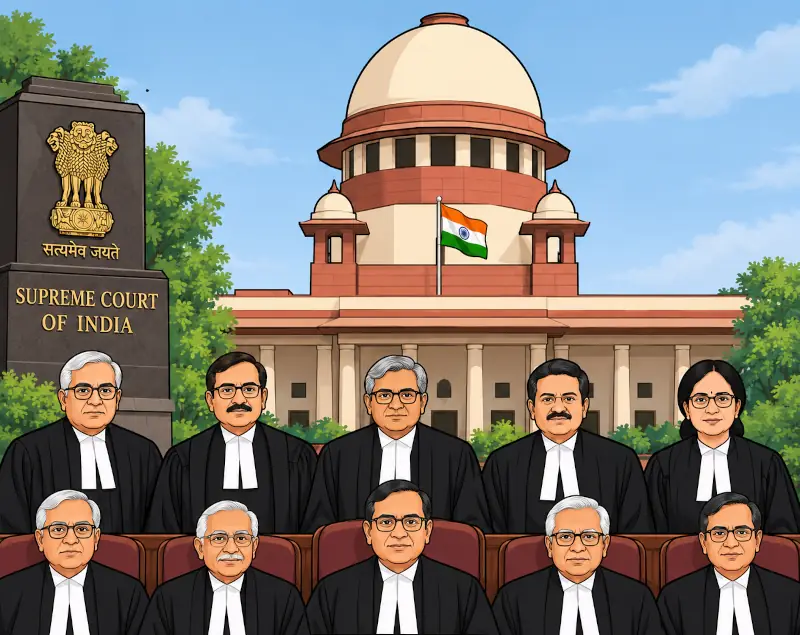
Supreme Court Collegium Recommends Three Supreme Court Judges Without Disclosing Merit for Appointment
October 3, 2026
The Supreme Court of India Collegium is an extra-constitutional, convention-based body which recommends persons for appointment as judges of the Supreme Court and High Courts. The Constitution of India does not expressly create an institution called the “Collegium”, nor does it prescribe a constitutional mechanism under that name through which judges of the Supreme Court select persons for appointment to the constitutional courts. The Collegium system developed through judicial decisions and constitutional convention and has subsequently become the operative mechanism for higher judicial appointments.
The Supreme Court Collegium, in its meeting held on 28 September 2026, recommended the elevation of three Chief Justices of High Courts as Judges of the Supreme Court of India: (i) Mrs. Justice Sunita Agarwal, Chief Justice, High Court of Gujarat, Parent High Court: Allahabad; (ii) Mr. Justice Devendra Kumar Upadhyaya, Chief Justice, High Court of Delhi, Parent High Court: Allahabad; and (iii) Mr. Justice Aparesh Kumar Singh, Chief Justice, High Court for the State of Telangana, Parent High Court: Jharkhand. The recommendations are ordinarily processed through the constitutional appointment mechanism and sent to the President of India for appointment.
The central difficulty is not merely the names recommended. It is the absence of publicly stated reasons for the selection. The Collegium announcement does not explain, in relation to each recommended judge, the particular merit, judicial record, constitutional contribution, quality of judgments, administrative performance, experience, comparative suitability or other identifiable consideration that caused the Collegium to prefer these three persons for elevation to the highest court of the country.
This creates a fundamental question of democratic accountability. Appointment as a Judge of the Supreme Court is not an ordinary administrative appointment. A Supreme Court Judge exercises enormous constitutional power: interpreting the Constitution, determining the legality of governmental action, deciding disputes between citizens and the State, determining questions affecting Parliament and the Executive, and giving authoritative interpretation of law for the entire country. When such an office is filled through a judge-controlled recommendation mechanism, citizens have a legitimate interest in knowing the basis upon which particular persons are considered suitable for that office.
The unusual feature of the Indian system is therefore the institutional concentration of the power of judicial selection within the judiciary itself. The same judicial institution whose judges exercise constitutional authority also participates decisively in selecting the persons who will become its future members. The Collegium is consequently not merely a recommending office in the ordinary sense; it represents a distinctive constitutional convention in which judges recommend judges for appointment to constitutional courts.
The question becomes still more serious when the recommendation is accompanied by little or no publicly intelligible explanation of individual merit. Transparency does not necessarily mean exposing confidential material or compromising judicial independence. It can simply mean stating the objective and intelligible reasons why a particular candidate has been selected over other persons who may also possess the necessary qualifications and experience.
India is therefore confronted with a distinctive constitutional problem: how can judicial independence be protected while ensuring public accountability in the selection of judges? The existence of an independent judiciary cannot by itself answer the question of who should select the judges of that judiciary and according to what standards.
The issue is not whether the three recommended judges are personally qualified or unqualified. The issue is the institutional process by which their names were selected. In a democratic constitutional system, appointment to the highest judicial office should not become a matter that the public can only accept without knowing the reasoned institutional basis of the recommendation.
The Indian Collegium system is therefore a constitutional anomaly requiring continuing public examination: an extra-constitutional judicial convention exercises decisive influence over appointments to the constitutional courts, while the reasons for individual recommendations are not ordinarily disclosed in a form that enables citizens to examine and understand the comparative basis of the selection. The larger democratic question remains unavoidable: if the judiciary is accountable to the Constitution, should the process by which its highest judges are selected also be sufficiently transparent for the people, in whose name the Constitution operates, to understand why particular individuals are chosen?
Bengali Summary:
স্বচ্ছতার অভাব বিচারব্যবস্থার প্রাতিষ্ঠানিক গ্রহণযোগ্যতা ও বৈধতাকে মারাত্মকভাবে ক্ষুণ্ন করে। বর্তমান প্রেক্ষাপটে ভারতের সুপ্রিম কোর্টের প্রধান চ্যালেঞ্জটি কিন্তু এই কলিজিয়াম প্রথাকে পুরোপুরি ভেঙে ফেলা নয়; বরং বিচারপতি মনোনয়নের ক্ষেত্রে একটি সুনির্দিষ্ট, বস্তুনিষ্ঠ এবং জনসমক্ষে উন্মুক্ত মূল্যায়নপদ্ধতি প্রবর্তন করা। যোগ্যতা ও মেধার মাপকাঠি ঠিক কী—তা সাধারণ মানুষের কাছে যতদিন না স্পষ্ট হচ্ছে, ততদিন পর্যন্ত অত্যন্ত যোগ্য বিচারকদের পদোন্নতির সুপারিশও তাদের গণতান্ত্রিক বৈধতার প্রশ্নে জনমানসে সংশয় ও বিতর্কের ঊর্ধ্বে উঠতে পারবে না

Author: tanmoy
Advocate, Completed LLB from BHU