Shyama Prasad Mukherjee: National Integration, Federalism and the Indian Union
Date: 29Th June 2026
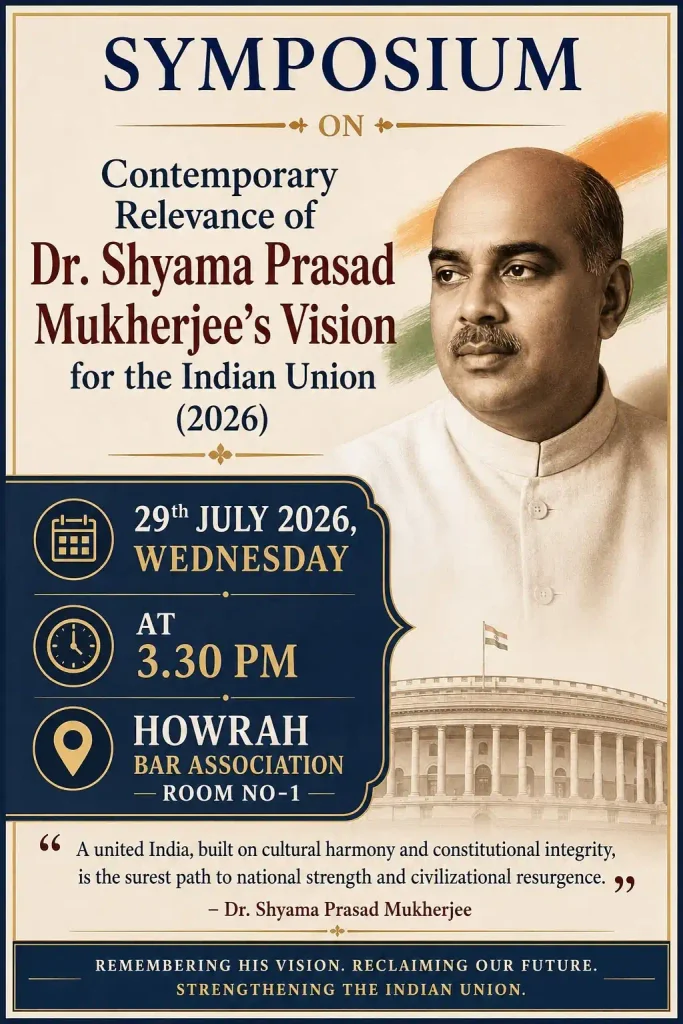
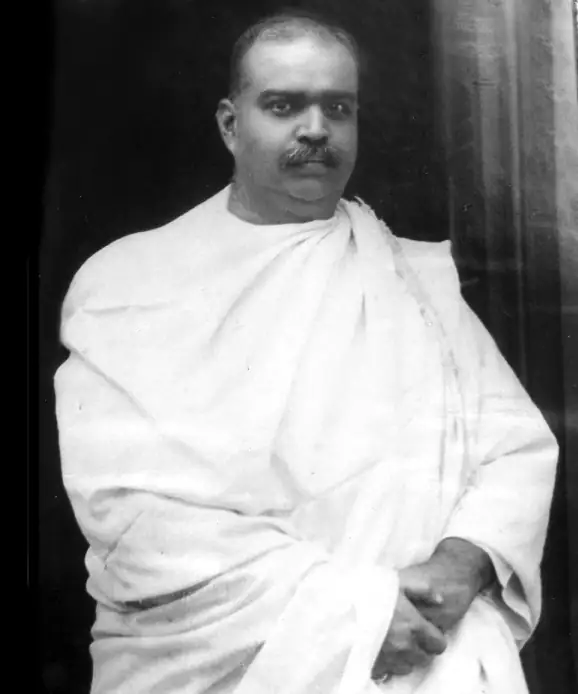
The Symposium on the Contemporary Relevance of Dr. Shyama Prasad Mukherjee’s Vision for the Indian Union (2026) is conceived as a major intellectual forum dedicated to a critical re-examination of the constitutional, political, economic, educational, and civilisational ideas of Dr. Shyama Prasad Mukherjee (1901–1953) in the context of twenty-first-century India. More than seven decades after his death, many of the questions that shaped his public life—national integration, federalism, constitutional equality, industrial self-reliance, educational excellence, border security, refugee rehabilitation, and cultural identity—continue to occupy the centre of Indian public discourse. The symposium seeks neither to celebrate nor to critique his legacy in isolation, but to examine it through rigorous historical scholarship, constitutional analysis, comparative political thought, and contemporary policy debates.
Dr. Mukherjee occupied a unique position in modern Indian history as an educationist, Vice-Chancellor of the University of Calcutta, member of the Constituent Assembly, India’s first Minister for Industry and Supply, and founder of the Bharatiya Jana Sangh. His political philosophy developed at the intersection of constitutional nationalism, democratic opposition, economic modernisation, and cultural consciousness. His advocacy of a politically integrated Union, equal constitutional citizenship, and the strengthening of national institutions became defining features of his public life, particularly in relation to the constitutional status of Jammu and Kashmir, refugee policy after Partition, and the relationship between the Union and the States.
The symposium will investigate how these ideas resonate with the constitutional and political realities of India in 2026. Discussions will explore the evolution of Indian federalism, cooperative and competitive federal governance, constitutional amendments, internal security, demographic changes, border management, and the balance between national unity and regional diversity. Special attention will be given to the historical development of policies concerning the territorial integrity of India and the changing interpretation of constitutional integration in the decades following Independence. These discussions aim to distinguish between historical context and present-day policy challenges while evaluating the enduring relevance of Mukherjee’s constitutional vision.
Another major theme concerns economic nationalism and industrial development. As the country’s first Industry Minister, Dr. Mukherjee argued that political independence required industrial strength, technological capability, and indigenous production. His role in laying the foundations of post-independence industrial institutions, heavy industries, public infrastructure, and manufacturing policy provides an important historical framework for analysing contemporary initiatives relating to manufacturing competitiveness, strategic industries, supply-chain resilience, and technological self-reliance. The symposium will assess how his economic ideas may be interpreted alongside present-day debates concerning industrial policy, innovation ecosystems, entrepreneurship, and national economic security.
Education will constitute another significant area of discussion. As one of the youngest Vice-Chancellors of the University of Calcutta, Dr. Mukherjee viewed universities as institutions responsible not merely for producing skilled professionals but also for cultivating intellectual leadership, civic responsibility, and national character. The symposium will therefore examine the relevance of his educational philosophy in relation to higher education reforms, research universities, knowledge production, language policy, academic freedom, technological education, and the relationship between education and nation-building in contemporary India.
The symposium will also encourage scholarly engagement with Dr. Mukherjee’s contribution to democratic politics. His resignation from the Union Cabinet, the establishment of an organised parliamentary opposition through the Bharatiya Jana Sangh, and his insistence upon constitutional debate as the foundation of democratic governance offer valuable material for understanding the evolution of India’s multi-party parliamentary system. Historians, political scientists, constitutional scholars, economists, jurists, and public intellectuals will be invited to place his political thought within broader traditions of democratic constitutionalism rather than examining it solely through contemporary political lenses.
A distinctive feature of the symposium will be its interdisciplinary methodology. Instead of limiting discussions to political history, it will integrate perspectives from constitutional law, strategic studies, economics, public administration, education, security studies, civilisational studies, political philosophy, and modern Indian intellectual history. Comparative sessions may also examine Mukherjee alongside other nation-builders of independent India, including Jawaharlal Nehru, B. R. Ambedkar, Vallabhbhai Patel, Rajendra Prasad, and Deendayal Upadhyaya, thereby situating his ideas within the larger intellectual evolution of the Indian Republic.
Ultimately, the symposium seeks to transform historical memory into informed academic inquiry. Rather than treating Dr. Shyama Prasad Mukherjee merely as a political figure, it proposes to examine him as a constitutional thinker, institution-builder, educationist, industrial planner, and advocate of national integration whose ideas continue to generate scholarly debate. By bringing together historians, constitutional experts, policymakers, jurists, researchers, and students, the symposium aims to deepen understanding of the evolving relationship between national unity, constitutional governance, democratic pluralism, economic development, and civilisational continuity in the Indian Union. In doing so, it will contribute to a more comprehensive appreciation of one of modern India’s most influential yet continually debated public intellectuals and statesmen, while encouraging evidence-based discussion on the future trajectory of the Indian Republic in the twenty-first century.